
A Study Series on Ephesians
This post is adapted from a sermon by the author. Resources are provided at the end of the post. Less than a 20-minute read, yet most meaningful as a meditation with an open Bible.
A number of years ago “the Los Angeles Times reported the story of an elderly man and wife who were found dead in their apartment. Autopsies revealed that both had died of severe malnutrition, although investigators found a total of $40,000 stored in paper bags in a closet.
“For many years Hetty Green was called America’s greatest miser. When she died in 1916, she left an estate valued at $100 million, an especially vast fortune for that day. But she was so miserly that she ate cold oatmeal in order to save the expense of heating the water. When her son had a severe leg injury, she took so long trying to find a free clinic to treat him that his leg had to be amputated because of advanced infection. It has been said that she hastened her own death by bringing on a fit of apoplexy while arguing the merits of skim milk because it was cheaper than whole milk.”[1]
Many Jesus-followers live in this same, sad condition.
As tragic as these stories may be, it many Jesus-followers live in the same condition. We either don’t realize the riches, the resources, the inheritance, the position that is ours in Jesus Christ, or for some strange, incomprehensible reason—much like Hetty Green—we have chosen to ignore it.
I would like to think that the reason is that we haven’t realized who we are. Perhaps we don’t understand the provision and position God has given us. This is one reason why a study of Ephesians is essential for Jesus-followers.
Where we are heading with this
This post gives an overview of the themes of Ephesians, an eagle-eye view. As we consider these themes, we discover that our position, inheritance, and power for victorious living, are all key teachings in the book. Most significant, the foundational truths and themes of Ephesians have to do more with the Source of our inheritance than it does with benefits we receive.
Soar like an eagle
Ephesians gloriously establishes essential truths, the bedrock of our faith and vital doctrine, that gives us eagle’s wings to soar into the heavenlies. It’s language and descriptions of this reality are eloquent and profound, yet the effect and application are eminently practical.
Ephesians gloriously . . . gives us eagle’s wings to soar into the heavenlies.
Chapters 1-3 gives us the “why” and chapter 4-6 offers us the “how.” It is not just “apple pie in the sky by and by.” It is relevant for us today. And it is not a book, like so many of Paul’s writings, that is an answer to issues or problems in the church—though some are dealt with in the book. Rather, it seems Ephesians wants to lift our eyes, to broaden our vision, to establish our understanding of not only our potential in Christ, but—most importantly—God’s intention through Christ. In Ephesians, we are drawn closer to understanding how God has glorified himself through Christ, how he is now glorifying himself through Christ in our lives (as we live for the praise of His glory), and how he will bring to himself for endless ages to come.
Themes in Ephesians
There’s so much nourishment packed into these six chapters, choosing themes to highlight really is just an appetizer. It’s as if we are sitting down to the finest wedding feast imaginable. As we view the incredible spread before us and soak in the tantalizing aromas, we want to be able to just devour the entire feast at once. Since that isn’t possible, we first turn our attention to the most prominent dishes.
Among other things, our Lord provides us with these leading themes in Ephesians:
- God and his sovereignty (1:6, 7, 11, 13-14, 17-22)
- The Son of God and his provision (1:3, 6-7)
- The grace of God so freely given in Christ (1:6, 2:4, 8)
- God’s ultimate pleasure and purpose fulfilled in Christ (1:9-10)
- The chosen of God (Jesus-followers everywhere) reflecting the glory of God (1:22, 23; 3:20, 21)
God and his sovereignty
From the very first verse, Paul wastes no time in establishing the central theme—God. For Paul, God is central. God is all in all.
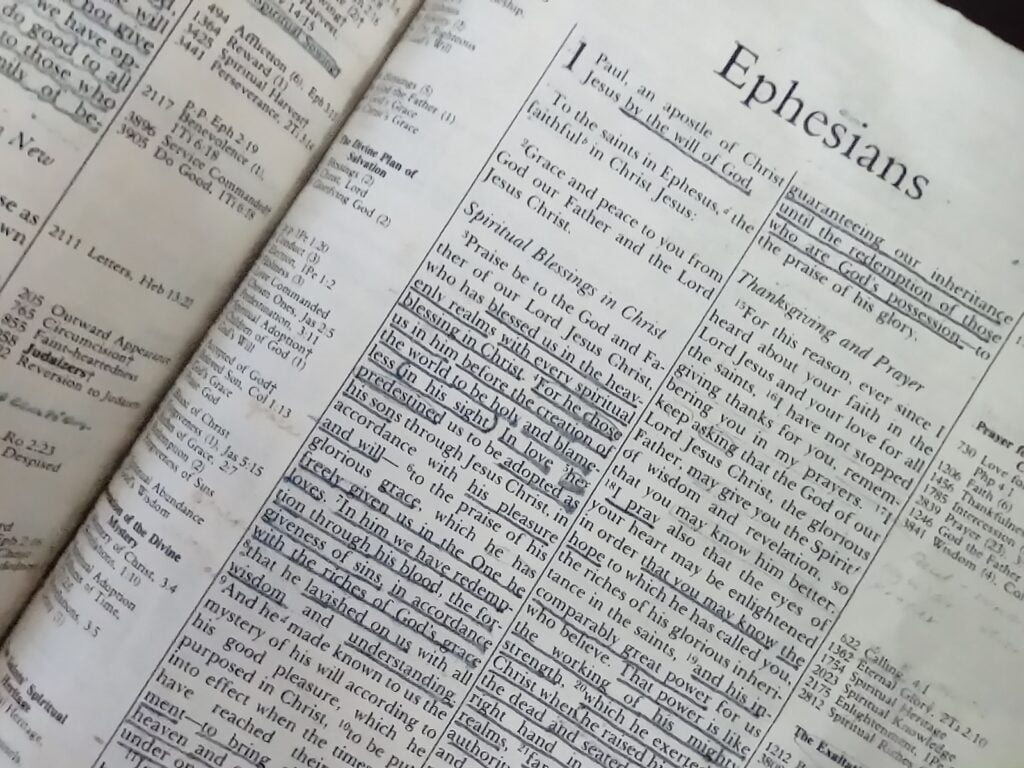
“Paul, an apostle of Christ Jesus by the will of God . . .” (1:1)
Paul is establishing that this letter to the church is from him, and he is establishing his credibility. He is Christ’s apostle. In some cases, an apostle was a person sent out to advance the gospel. And Paul was Christ’s apostle in this sense. In another sense, the apostles were those chosen by Christ to offer the foundational leadership and teaching of the early church—leadership and teaching we still stand upon. Paul was also an apostle in this sense since he was met by Christ that day on the road to Damascus. He identifies himself as Christ’s apostle to the Gentiles (Romans 11:13).
What we notice as Paul opens this letter is that he also seems to initiate the central theme: God! He wants to make the point that he is who he is by the will of God. God is the sovereign. He has chosen and appointed Paul. I think that this not only gives him and his message credibility as we read this letter, but it also probably gave Paul a great deal of peace. In all his life God was the foundation.
Peace that flows from God’s sovereignty is freely received in the Jesus-follower’s full surrender to God.
Peace that flows from God’s sovereignty is freely received in the Jesus-follower’s surrender to God. Some may think sovereignty makes God the Big Boss—and he is! But bending our will to God’s will does not bring crippling bondage. Rather, God’s loving reign sets us free!
In what other ways is the centrality of God communicated in Ephesians?
- It is God who has blessed us with all the blessing of the heavenlies. (1:1)
- God has chosen us and adopted us. (1:4)
- God has given us redemption and forgiveness of sins. (1:6, 7)
- It is God’s grace we are so freely given. (1:7)
- It is God’s purposes that are being fulfilled. (1:9, 10)
- We are God’s possession—to the praise of His glory. (1:14)
- It is God’s “incomparably great power” that is given to us. (1:18)
- God exalted Jesus to the highest place. (1:22)
Do you get a feel for this great theme? We can trace this emphasis through all six chapters. It is a great study.
The implications of God’s sovereignty
What are the implications of God’s centrality and sovereignty? Let’s think about the idea of kingship.
A king is sovereign over his land. He has the right to rule. What he says goes. And generally, because a king has the best interests of his domain at heart, his authority is a good influence which benefits those under his reign. Though this isn’t always so with man, it is consistently true for God. God’s sovereign reign flows from his untarnished goodness, love, and justice. As a result, we feel very good about it. There is a peace for all who open their hearts and minds to God’s sovereignty.
God’s sovereign reign flows from his untarnished goodness, love, and justice.
Another way for us to begin to understand God’s sovereignty is by considering the relationship between an artist and his canvas. An artist applies the color and design to his canvas with his brush to reflect the thoughts, emotions, and purposes of his heart. The canvas and paint are not sovereign over the artwork. It is an image reflecting the heart of the artist. So it is with God and his creation.
For us, the sovereignty of God is portrayed through the magnificent colors and details placed upon the canvas of time. On that canvas, God has gloriously and sovereignly splashed the history of his love for us. On that canvas are the dark colors of His broken heart in Eden, blended with the bright hope of Calvary. On that canvas is your life and mine. God has carefully and strategically placed you and your fellow Jesus-followers on the canvas of time, contributing to the impact of God’s glory in worship, community, and loving outreach. Over it all, he is sovereign. We are God’s artwork on the canvas of time, reflecting the beauty of his heart.
We are God’s artwork on the canvas of time, reflecting the beauty of his heart.
The Son of God and his provision
As we reflect on the canvas and themes of Ephesians, we also see that the Lord Jesus Christ plays the prominent and glorious role in the work of art called God’s eternal goodness and purpose.
- Paul establishes that he is an apostle of Jesus Christ. (1:1)
- The grace and peace we are given from God is from the Lord Jesus Christ. (1:2)
- Our heavenly spiritual blessings are found in Christ. (1:3)
- When we were chosen by God, it was in him. (1:4)
- Our adoption into God’s family is through Christ. (1:5)
- The glorious grace we are given by God is in the One He loves. (1:6)
- It is through Christ’s blood that we have our redemption. (1:7)
- God’s purposes are fulfilled in Christ. (1:9)
- All things will be brought together under one head, even Christ. (1:10)
- Our hope is in Christ. (1:12)
- We are included in Christ through our salvation. (1:13)
Perhaps we could say that if God is the artist, then Christ is the brush and paint. But can we even offer that symbolism since Scripture makes clear that God and His Son are together, working together in tandem? Indeed, Jesus explained, “I and the Father are one” (John 10:30). And a close look at first four verses of chapter 1 reveals the Father and the Son operating hand-in-hand.
The grace of God so freely given in Christ
A companion theme that we can identify throughout Ephesians is the grace of God. Grace is something that we are freely given which we do not deserve.
In What’s So Amazing About Grace?, Philip Yancey offers us a parable which helps us understand grace—being freely given which we do not deserve.
“A vagrant lives near the Fulton Fish market on the lower east side of Manhattan. The slimy smell of fish carcasses and entrails nearly over-powers him, and he hates the trucks that noisily arrive before sunrise. But midtown gets crowded, and the cops harass him there. Down by the wharves nobody bothers with a grizzled man who keeps to himself and sleeps on a loading dock behind a dumpster.
“Early one morning when the workers are slinging eel and halibut off the trucks, yelling to each other in Italian, the vagrant rouses himself and pokes through the dumpsters behind the tourist restaurants. An early start guarantees good pickings; last night’s uneaten garlic bread and French fries, nibbled pizza, a wedge of cheesecake. He eats what he can stomach and stuffs the rest in a brown paper sack. The bottles and cans he stashes in plastic bags in his rusty shopping cart.
“The morning sun, pale through harbor fog, finally makes it over the buildings by the wharf. When he sees the ticket from last week’s lottery lying in a pile of wilted lettuce, he almost lets it go. But by force of habit, he picks it up and jams it in his pocket. In the old days, when luck was better, he used to buy one ticket a week, never more. It’s past noon when he remembers the ticket stub and holds it up to the newspaper box to compare the numbers. Three numbers match, the fourth, the fifth—all seven! It can’t be true. Things like that don’t happen to him. Bums don’t win the New York Lottery.
“But it is true. Later that day he is squinting into the bright lights as television crews present the newest media darling, the unshaven, baggy-pants vagrant who will receive $243,000 per year for the next twenty years. A chic-looking woman wearing a leather miniskirt shoves a microphone in his face and asks, ‘How do you feel?’ He stares back dazed and catches a whiff of her perfume. It has been a long time, a very long time since anyone has asked him that question.
“He feels like a man who has been to the edge of starvation and back and is beginning to fathom that he’ll never feel hunger again.”[2]
What a tragic ending if the vagrant hadn’t turned in the lottery ticket! So much better than a mere winning lottery ticket, the Father has “has blessed us (Jesus-followers) in the heavenly realms with every spiritual blessing in Christ” (1:3). Sadly, we still often live like the pitiful vagrant in Yancey’s story.
So much better than a mere winning lottery ticket,
the Father has “has blessed us (Jesus-followers) in the heavenly realms
with every spiritual blessing in Christ.”
What can we notice about this grace theme as we continue with this appetizer on Ephesians?
- Grace and peace come from God and our Lord Jesus Christ. (1:2)
- All that God has done, continues to do, and will yet accomplish for us in Christ is feely given glorious grace (1:5, 6)
- God’s grace is described as his riches which he has lavished on us. (1:7, 8)
- Everything spoken of in Ephesians which is given to us—God’s power, peace, redemption, inheritance, adoption—all flow from God’s grace.
- It is by grace that we are saved (2:5, 8) and live—and it is what we can expect in the future!
Amazingly, the grace extravagantly given us includes ring-side seats in the heavenly realms for the ages to come.
Amazingly, the grace extravagantly given us includes ring-side seats in the heavenly realms for the ages to come. Why and how? Slowly, reverently read the following two verses: “And God raised us up with Christ and seated us with him in the heavenly realms in Christ Jesus, in order that in the coming ages he might show the incomparable riches of his grace, expressed in his kindness to us in Christ Jesus” (2:6-7).
It’s all about God’s glory and grace!
Okay, this is must emphasized. Let’s look closely at our Bibles. In love God chose and adopted us (1:4-6). This was his “pleasure and will–to the praise of his glorious grace which he has freely given us in the One he loves” (emphasis added). It’s all about God’s glory and grace! God’s purpose in redeeming us is to profusely pour out his grace on us (1:7-9), and it will forever be on display! (2:6-8)
It’s not just “once upon a time.” It is “happily ever after”!
Let’s be certain and clear. This is not because we are worthy or deserve it. On the contrary, it is to show his infinite worth. No other one would (or even, could) be so loving, so generous, so lavish!
The purpose of God fulfilled in Christ
The theme of God’s purposes being fulfilled in Christ is closely related to the centrality of God, the active role of the Son, and God’s lavish grace. Although this theme is also reflected throughout the book, let’s focus on 1:9-10.
“And he made known to us the mystery of his will according to his good pleasure, which he purposed in Christ, to be put into effect when the times will have reached their fulfillment—to bring all things in heaven and on earth together under one head, even Christ.” (Emphasis added.)
Nearly everyone likes a good mystery. There is suspense, vivid and memorable characters, a great story line.
In Ephesians we are told that the mystery of God’s will is finally revealed. It involves his eternal purposes for the world. It involves his Son, Jesus Christ, and his Holy Spirit. And by God’s stunning grace, it involves us.
The bottom line is that God intends, and has intended all along, to bring all things in heaven and on earth together under one head, even Christ (1:10). In the coming posts we will discover more clearly what that means—for the church, the world at large, and for us personally.
The Church of God (the chosen of God) reflecting the glory of God
Having established the theme and priority of God being all and in all, that all is possible through Jesus, and that the theme of undeserved grace is prominent, we are also a theme in this amazing book. More precisely, it’s not that we are a theme, but God’s goodness for us and his wonderful intention for us is a theme.
As we consider these truths and how they fit into our lives we will be lifted with eagle’s wings. We will realize the riches, the resources, the inheritance, the position that is ours in Christ. In contrast to miserly, sick Hetty Green who had it all but availed of nothing, we have it all, and by God’s grace, we will live worthy of the calling which we have received (4:1). Our lives and church will be deeply impacted. The wealth we have been given in Christ will bring solid and resounding glory to God.
On the canvas of time, Jesus-followers have been gloriously painted in with vivid, God-honoring colors for this day and hour. God will fulfill His purposes to the praise of His glory through his church and our lives. But we must realize, he holds the brush, he has given the resources, and he sovereignly works for his glory and our good.
What of us personally?
Paul probably found great peace in knowing that he was called to be an apostle by the will of God. Knowing that God is in control, that he is a work, that he has called us, that he has made us according to his eternal purposes, that he is the master artist painting the beauty of our lives with both broad strokes and detailed attention—well, it can give us a great deal of peace and strength.
No matter what your situation today, you can experience God’s peace.
No matter what your situation today, you can know God’s peace. He is in control. He reigns over all. He has not abandoned you, nor ever will. In fact, according to the truth written to us in Ephesians, God has already provided all you need to enjoy a glorious relationship with him, to have confidence that your life has purpose and direction, and to be certain that the grace he provides is an artesian-well of power for your victory and his glory. And that is a well that will never run dry.
[1]MacArthur, John F. The MacArthur New Testament Commentary. Chicago: Moody Press, 1983.
[2]Yancey, Philip. What’s So Amazing About Grace? Grand Rapids, MI: Zondervan Publishing House, 1997.
Resources
Lloyd-Jones, D. Martyn. God’s Ultimate Purpose: An Exposition of Ephesians 1. Grand Rapids, MI: Baker Books, 1978.
MacArthur, John F. The MacArthur New Testament Commentary. Chicago: Moody Press, 1983.
Yancey, Philip. What’s So Amazing About Grace? Grand Rapids, MI: Zondervan Publishing House, 1997.
Scripture references are from the NIV (New International Version, 1984) unless otherwise noted.